AirClean portable air purifier: what the claims mean
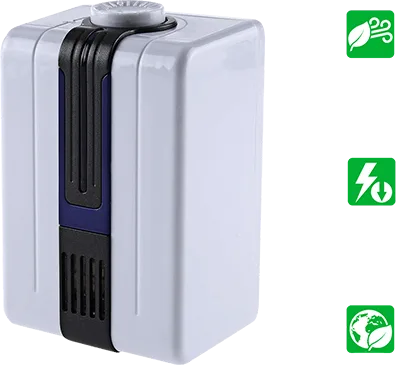
The AirClean portable air purifier is promoted as a pocket-sized fix for dust, smoke, pollen and odors. Some of that is plausible. Some of it depends on wording that is easy to skim past. This page goes through the typical advertising claims and tells you what each one is likely to mean in a real room.
What the AirClean portable air purifier claims to do
The AirClean listing promised the removal of up to 98% of airborne particles, no filter to replace and very low power use. Ads for compact purifiers like this one also tend to add "removes viruses and allergens" and "covers your whole room." Each claim rests on a different level of evidence.
A figure like 98% normally comes from a lab test in a sealed chamber of a cubic meter or less, often over several hours. A bedroom is about 30 to 40 cubic meters. The same device in that space has far less effect, and the number does not carry over.
"Removes viruses" is the weakest claim. A filter can trap particles of a given size, but that is not the same as lowering infection risk in a home. Treat it as marketing language unless a named test report is shown.
Filter type and what it can catch
The filter decides almost everything. A true HEPA filter captures at least 99.97% of particles at 0.3 microns. Phrases such as "HEPA-type," "HEPA-like" or "medical grade" have no fixed standard behind them.
Small units often add an ionizer. Ionizers can produce a little ozone, and the amount varies by design. If you have asthma or a sensitive chest, a plain mechanical filter is the safer choice.
- Look for a stated filter grade (H13 or H14 is the usual true HEPA range).
- Check whether an activated carbon layer is included, since that is what handles odors.
- Confirm the ionizer can be switched off.
Room size and airflow
The number that matters is CADR, the clean air delivery rate, measured in cubic meters per hour or cubic feet per minute. Many handheld and desktop purifiers do not publish one, which tells you something already.
As a rough guide, a purifier needs a CADR of about two thirds of the room's floor area in square feet to work well. A 150 square foot bedroom wants a CADR near 100. Small portable units often manage 10 to 30, so a realistic target is a desk, a car or a space under 10 square meters.
Noise, power and running costs
Compact purifiers run on a USB cable or a small battery. Expect around 3 to 10 watts, which costs only a few cents a day. Battery life claims of 8 to 10 hours usually apply to the lowest fan speed.
Noise is quoted at the lowest setting too, typically 25 to 35 decibels. At the top setting, a small fan can sound closer to 45 or 50 decibels, which is noticeable at night.
"No filter to replace" deserves a second look. A unit without a filter to change usually cleans the air with an ionizer or a washable electrostatic plate. That saves on running costs, but it captures fine particles less reliably than a true HEPA filter, and an ionizer can give off a little ozone. Purifiers that do use filters need a new one every 3 to 6 months, at roughly 10 to 25 dollars each.
How to judge the AirClean claims yourself
Ignore the headline percentage and look for the boring details: filter grade, CADR, test method and ozone output. If a listing hides all four, the unit is probably a fan with a thin filter.
Air quality is also tied to water and surfaces in the home. If you are comparing gadgets in the same category, our notes on the H2O Shield water-repellent coating show how to read durability claims in a similar way. For cleaning tools that make bold promises, the EZclean magic brush is another example worth a skeptical look.
Solar-powered gadgets raise the same questions about advertised output versus real output, which the Aquasun solar review looks at in detail.
Frequently Asked Questions
Does a portable air purifier work in a whole bedroom?
Only if its CADR matches the room. Most tiny units are rated for personal space, like a desk or a car cabin. In a full bedroom you would see little change in measured particle levels.
Is the ionizer in a small purifier safe?
Ionizers can release small amounts of ozone, which irritates the lungs. Choose a model where the feature can be turned off, or one that lists tested ozone output below 0.05 parts per million.
How often should the filter be replaced?
Every 3 to 6 months is typical, sooner in dusty homes or with smokers. A visibly gray filter or a drop in airflow means it is already past its best.
Can it remove cooking smoke and odors?
Only partly. Odors need a real activated carbon layer of reasonable thickness, and many compact units include only a thin sheet. For heavy cooking smells, ventilation does more than a small purifier.